 />
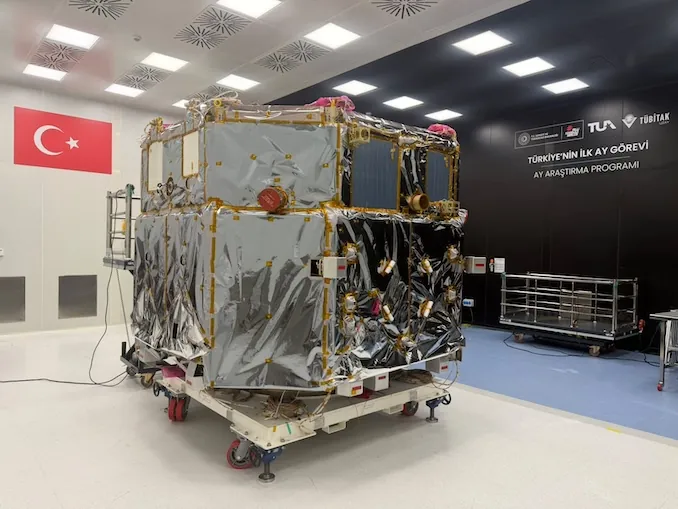
The Turkish Lunar Mission 1 (TLM-1) spacecraft is shown in a clean room following the completion of vehicle integration. Image: Tübitak Uzay
Turkey aims to launch its first mission to the Moon in next year, the first in a planned two-mission series, which includes an orbiter and a lander.
The First Turkish Lunar Mission (TLM-1) is contracted to launch onboard a SpaceX Falcon 9 rocket between April and June with mission managers aiming for an April flight. A launcher for TLM-2 has yet to be selected.
If successful, Turkey would become the ninth sovereign nation (or collection of nations as is the case with the European Space Agency) to operate a payload in the lunar environment, following China, ESA, India, Israel, Japan, Russia, South Korea, and the United States.
Dr. Burak Yağlioğlu, the project manager for the Turkish Lunar Mission, gave an overview of the mission objectives and progress to launch during the International Astronautical Congress (IAC), hosted by the International Astronautical Federation (IAF) in Turkey earlier this month.
“As a nation with a moon on its flag, going to the Moon is a very, very, very long dream for us and that’s why it has a very important national meaning, going to the Moon with our own capabilities,” Yağlioğlu said during his presentation at the IAC. “The Moon is also very important for the Earth.”
“The Moon is the Earth’s gateway to the solar system, so it may be discussed as a hub for interplanetary missions or deep space exploration, but if we look into some of the pillars of these aspects, we have science, technology development, international cooperation, resource utilization, and in the end, the ultimate goal: sustained presence,” he added.
The Turkish Lunar Mission, also referred to as the Lunar Research Program, is comprised of two initial, uncrewed phases. TLM-1 is an orbiter built by Turkish company, Tübitak Uzay, along with another company, DeltaV, which provided a hybrid propulsion system that uses nitrous-oxide as the oxidizer and a polymeric solid as the fuel.
Teams also have support from the Turkish Space Agency (TUA).
The roughly 3.6 ton TLM-1 spacecraft maneuvers using two propulsion systems: a bi-proellant chemical propulsion system for the thrusters and a hybrid propulsion system for its main engine. The hybrid system will be fired once in Earth orbit for the translunar injection burn and again for the lunar insertion burn.
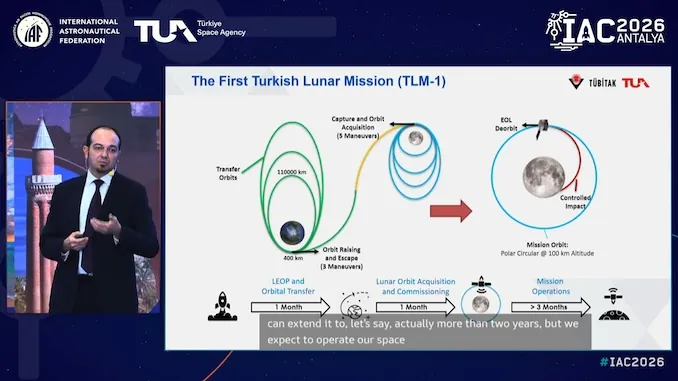 />
TLM-1 is designed operational life of at least five months and is designed to operate in a 100 km circular polar lunar orbit once it reaches the Moon.
Yağlioğlu said it’s a point of national pride that more than 80 percent of the equipment onboard the TLM-1 (56 out of 65 elements) are made domestically in Turkey.
“We have several Turkish partners while we develop this spacecraft, so we actually have the heritage, we have the experience, we have the capability, but we also try to build an ecosystem with startups and new companies to make our system like a national team, and we actually had new actors contributing to our lunar mission two,” Yağlioğlu said.
TLM-1 includes a suite of four science payloads: the Lunar Neutrals Telescope (LNT), the Lunar Narrow Field of View Radiometer (LNR), the Radiation Calorimeter, and the Radiation Dosimeter. It’s three imaging and navigation payloads are: a High Resolution Camera, a Wide Angle Video Camera, and a Vision Based Navigation System.
These combination of instruments will be used by researchers to better understand various elements of the lunar environment, like radiation; impacts from solar wind and meteoroid impacts; magnetic anomalies; and surface temperature.
“With the TLM-1, we have an integrated observatory. So, if we just recall the external drivers and modulating conditions, we are going to measure them with LNT and LNR and with the cameras we have, maybe we will identify some meteorite impacts too,” Yağlioğlu said.
“But in addition to that, we also have the radiation measurements or environments. So all of them will contribute to the scientific outputs.”
This week, the TLM-1 spacecraft begins the first in a series of environmental tests, starting with a thermal vacuum chamber test.
As for the status of the TLM-2 mission, Yağlioğlu said it’s still early in development, but it will include a lander that will deploy a rover on the surface of the Moon. He noted the the TLM-1 design is modular and many elements can be replicated for the TLM-2 lander.
One demonstration of transferable capabilities will come when they are performing the end-of-life deorbiting of TLM-1.
“With the propellant left, we would like to design a guidance to a target area and make a controlled impact,” Yağlioğlu said. “So this will be a kind of rehearsal for the lander mission too.”
A launch date for TLM-2 hasn’t been announced.
Falcon 9 ← Back to News Archive