 2
Using data from the joint European and Russian ExoMars Trace Gas Orbiter at Mars, an international team of scientists has discovered new evidence of volcanic activity on the red planet’s surface. Newly formed fissures in the surface seemingly allow gases from subsurface volcanic hotspots to rise to the Martian surface.
These gases are primarily composed of hydrogen chloride, which the Trace Gas Orbiter first detected in the Martian atmosphere in 2021. Hydrogen chloride is normally found within magmatic vents in volcanic regions on Earth, suggesting the same might be occurring on Mars.
“Our findings suggest that Mars has retained enough internal heat to support volcanic activity until recently, and possibly still does,” said co-author Daniel Mège of the Polish Academy of Sciences.
These volcanic fissures are found in the environment surrounding the Alba Mons volcano, located in the northern Tharsis region of the red planet, north of the three Tharsis volcanoes — Arsia Mons, Pavonis Mons, and Ascraeus Mons — and Olympus Mons. Alba Mons is the largest volcano on Mars by surface area, reaching an elevation of 6.8 km at its highest point, and some of the volcanic deposits around the volcano are over three billion years old.
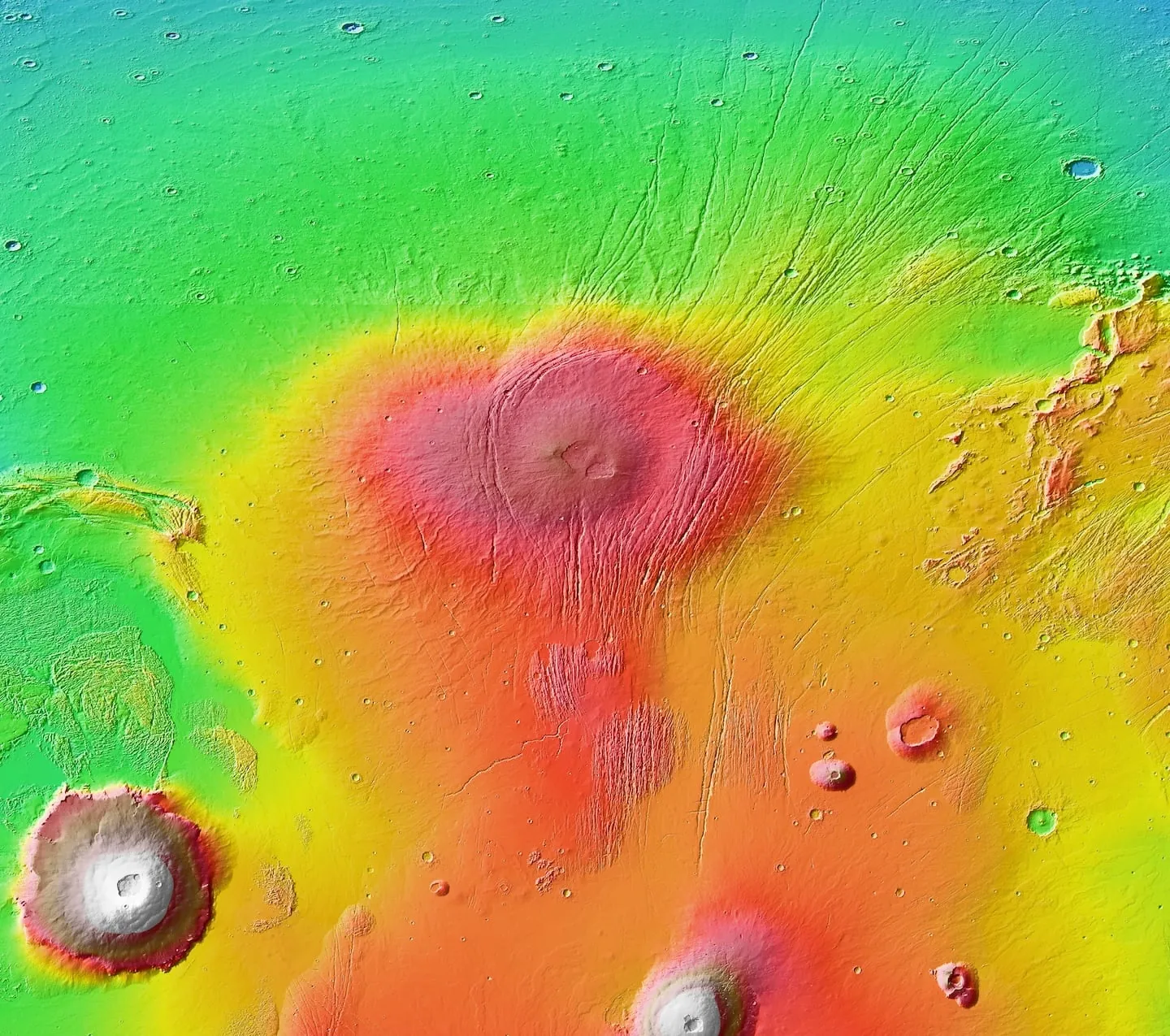 />
Topographic image of the northern Tharsis region showing Alba Mons (center), Olympus Mons (lower left), and Ascraeus Mons (lower right). (Credit: NASA/JPL-Caltech/Arizona State University)
While Mars is known to host the largest volcanoes in the solar system, the extent of its volcanic activity remains unknown. Orbiters have captured imagery suggesting that some volcanoes were active only a few million years ago, and missions like NASA’s InSight lander have recorded thousands of “marsquakes” — both of which suggest that the planet is still geologically and volcanically active. Nonetheless, no volcanic eruptions have ever been observed on Mars, challenging the idea that the red planet is still volcanically active.
The hydrogen chloride vents were discovered when Mège et al. were reviewing Trace Gas Orbiter (TGO) data and noticed sharp increases in atmospheric hydrogen chloride during the early summer in the Martian northern hemisphere. These spikes in the gas were surprising, as hydrogen chloride gas wasn’t typically found in the northern Tharsis region, especially during the early summer season. Hydrogen chloride typically peaks in the Martian atmosphere during the northern hemisphere’s winter, fluctuating with the planet’s dust and water cycles.
However, after combing through historical data, hydrogen chloride was found to consistently peak in the northern hemisphere’s early summer period, always around Alba Mons and its flanks.
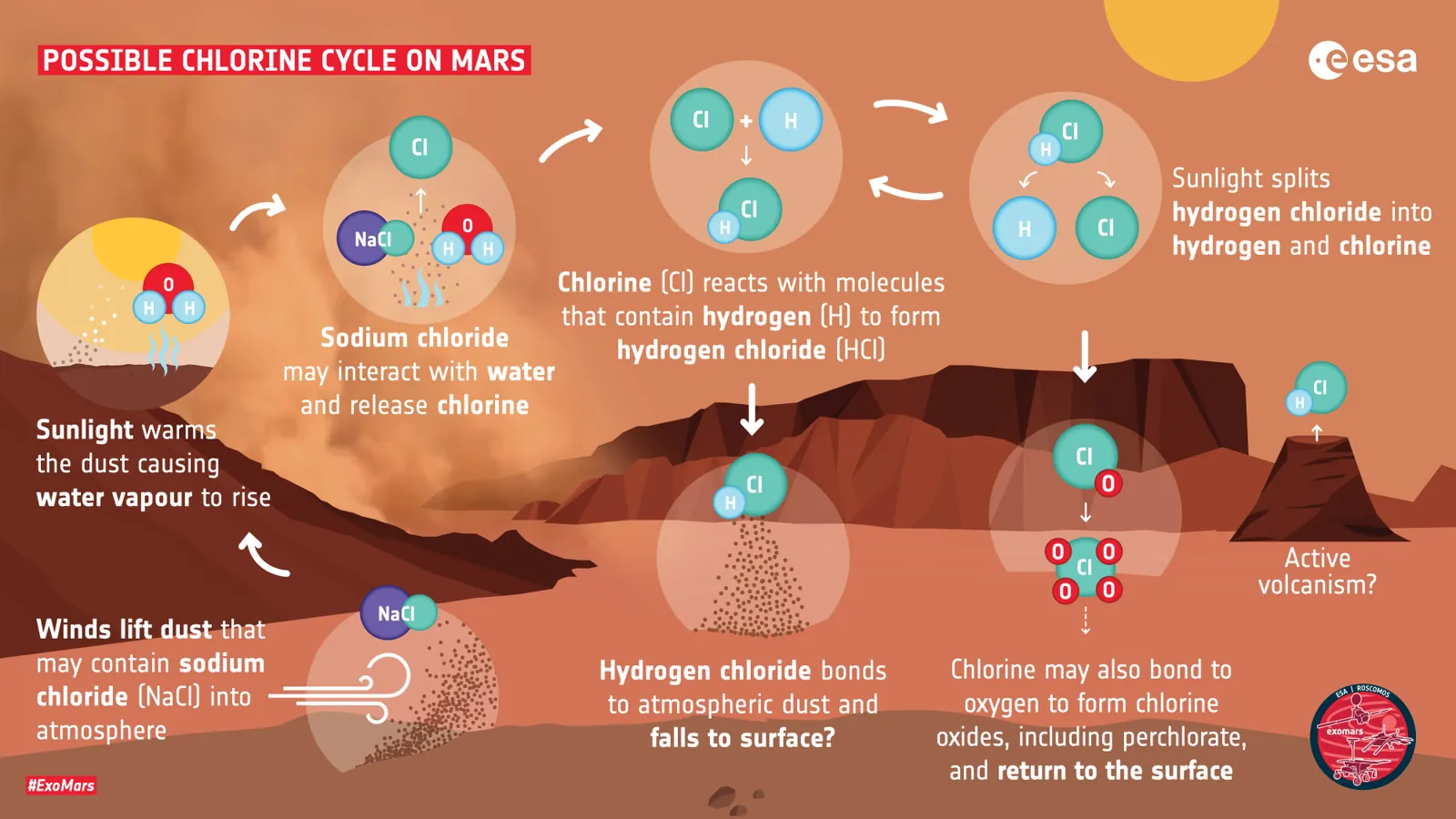 />
Infographic highlighting how hydrogen chloride may be created on Mars. Note the “Active volcanism?” tag on the far right. (Credit: ESA)
Mège et al. found that, through atmospheric and geological analyses of Mars, hydrogen chloride emissions occur just after the ice and frost of Martian winter melt and sublimate. TGO’s Colour and Stereo Surface Imaging System (CaSSIS) instrument studied the region using its high-resolution, 4.5 m-per-pixel color stereo camera, as well as the Atmospheric Chemistry Suite (ACS) instrument, which includes three infrared spectrometers.
The ACS instrument was first used to characterize and localize the emission of hydrogen chloride gas. Then, once localized, the team used TGO’s CaSSIS to image the region, revealing young, narrow fissures in the Martian surface spanning tens to hundreds of meters. Furthermore, these fissures appeared to influence color changes in the Martian surface surrounding them.
“The Trace Gas Orbiter was able to find the smoking gun. It was like looking for a needle in a haystack. It’s truly amazing that it spotted a handful of molecules from a perhaps intermittent source, whilst moving continuously along its orbit to monitor the whole Martian atmosphere,” Mège said.
Following additional data analysis, the team believes the hydrogen chloride gases are rising through these fissures, similar to other magmatic vents on Earth. During the winter, the openings of these fissures are frozen over due to temperatures as low as -120 degrees Celsius, preventing the hydrogen chloride gas from being emitted at its normal rate. The trapped gases are then released in early summer, once the ice sealing the fissures melts.
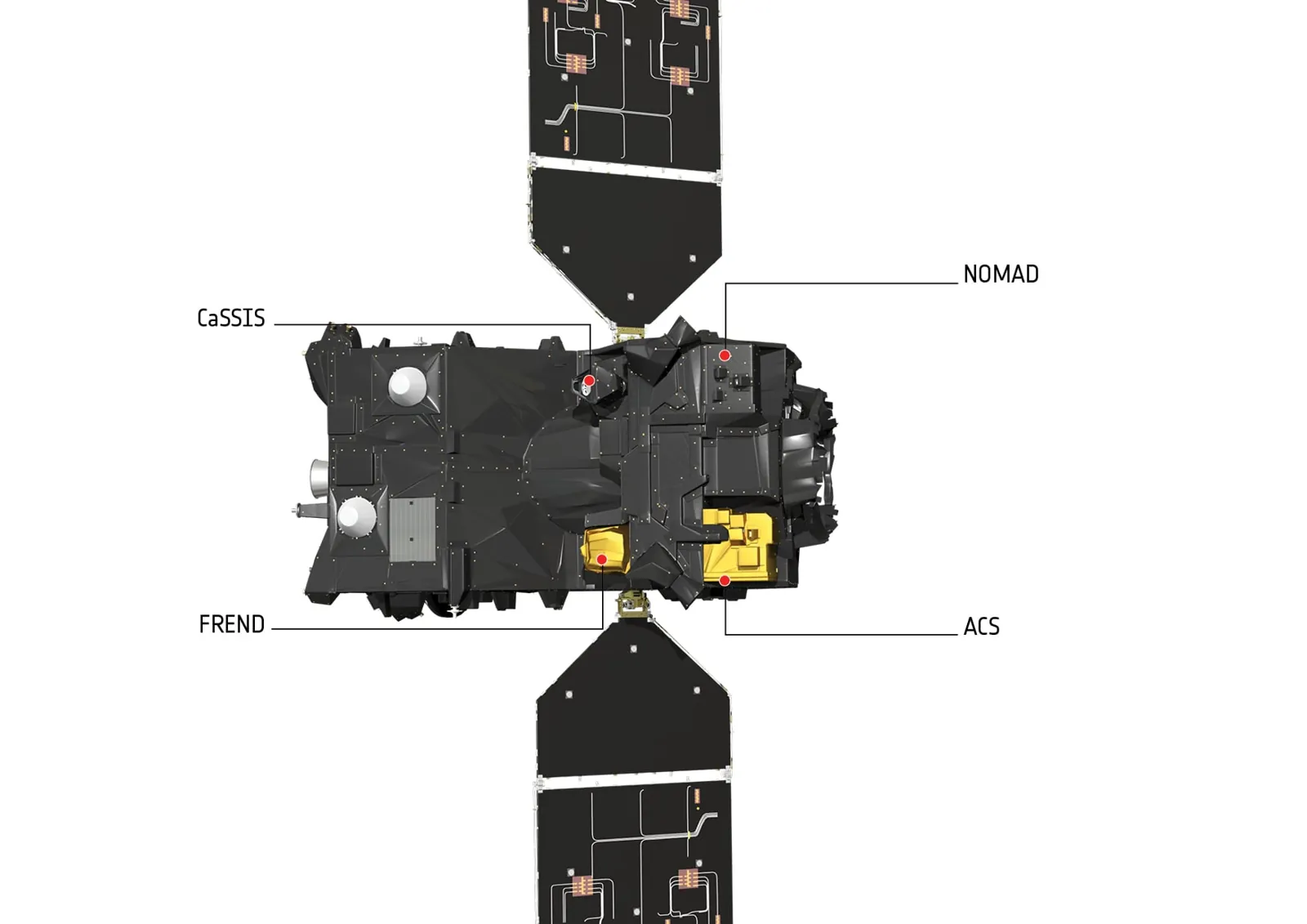 />
Diagram highlighting the locations of instruments on TGO. (Credit: ESA)
The surface color changes surrounding the fissures are also likely due to deposits left behind by gases escaping from Mars’ interior. Such a phenomenon is also observed at magmatic vents on Earth. The team’s testing suggests that the hydrogen chloride emissions are linked to a dormant magma chamber below Alba Mons, which serves as a sort of “volcanic plumbing system.”
“Looking at the spatial distribution of the seeping, it became instantly obvious to me that there was something volcanic behind it, but it had to be demonstrated. A huge part of the work consisted of examining all the possible chemical processes going on in the Martian atmosphere. We needed to be rigorous, critical, and creative to explain the presence of hydrogen chloride. The data were complex, but also excellent brain food,” Mège explained.
Hydrogen chloride and other magmatic gases are known to have contributed to the formation of a thick atmosphere and a warmer climate when they were more abundant on Mars millions of years ago, conditions that once allowed abundant liquid water to flow across the red planet. These fissures, if they were to one day allow subsurface magma to reach the surface and interact with groundwater, could become small regions with habitable conditions.
“Looking for Martian life in the seeping fissures of the Alba Mons region would make a lot of sense. If hydrothermal systems are active, they could contain the ingredients and energy needed for microorganisms to develop, and shield microorganisms from the hostile and changing environment above the surface,” said Mège.
For TGO, a joint European Space Agency (ESA) and Roscosmos mission under the ExoMars program, the findings could be its most significant yet. The orbiter launched atop a Proton rocket from Kazakhstan in March 2016 and was inserted into a circular orbit around Mars measuring 400 by 400 km in October 2016. Designed to investigate and understand methane and other trace gases in Mars’ current atmosphere, TGO and Mège et al.’s findings highlight the orbiter’s capabilities to identify potential habitable areas by simply observing the atmosphere.
“These findings may prove to be TGO’s greatest success yet,” noted TGO project scientist Colin Wilson of ESA.
Mège et al.’s results were published in the Science Advances journal on Nov. 4.
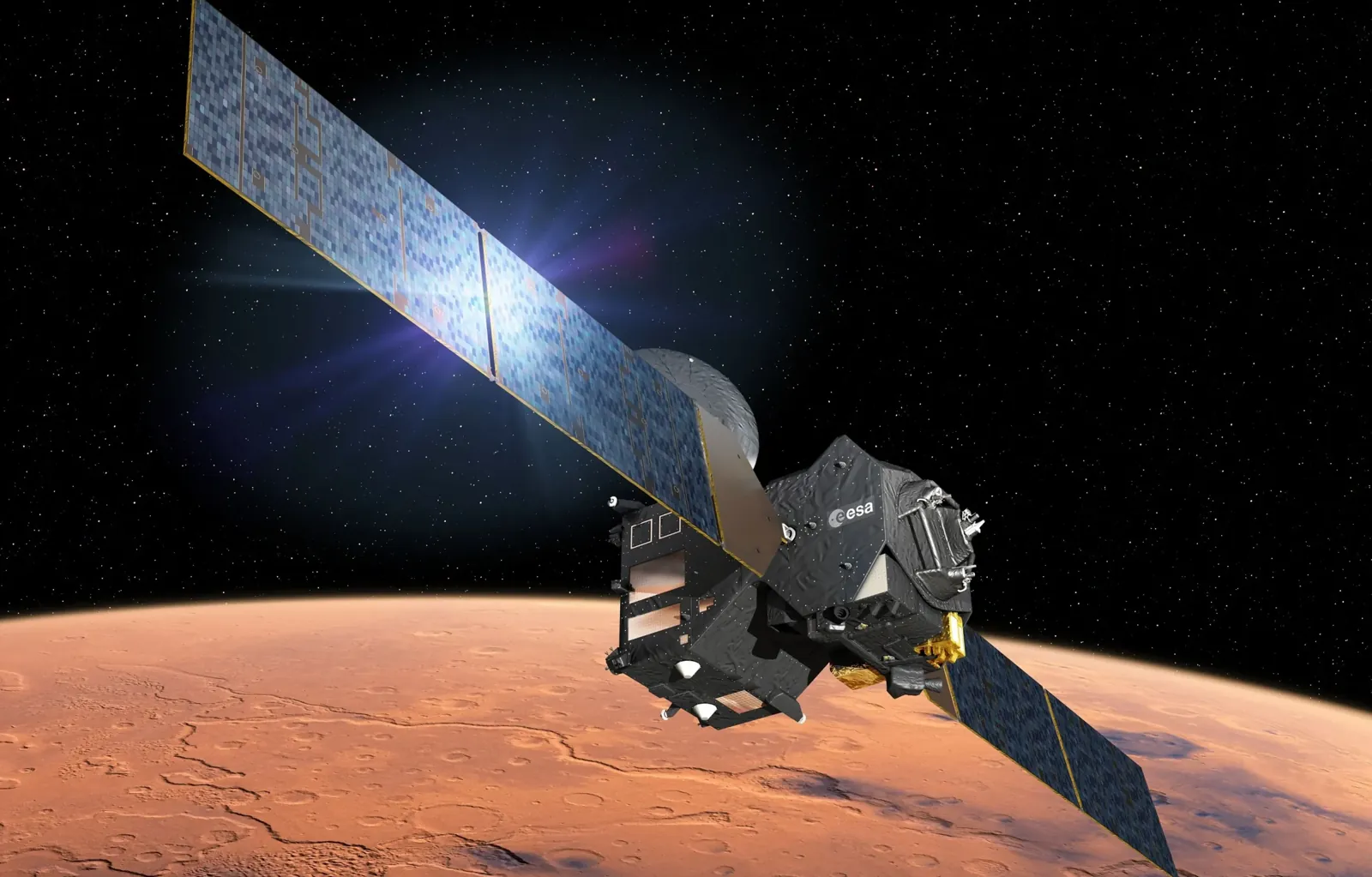
(Lead image: Artist’s impression of TGO in orbit around Mars. Credit: ESA)
Alba MonsESAEuropeanExomarsMarsMartianred planetRoscosmosRussianTGOTrace Gas Orbitervolcanic activityVolcano 0 FacebookTwitterPinterestEmail previous article Avoiding an uncontrolled reentry; boost Hubble and keep the science – Isaacman />