 6
Seven rockets from four countries are set to launch this week. Starship is set to attempt its most consequential mission yet, while Falcon 9 is set to launch a pair of classified payloads for the United States Space Force. The United Launch Alliance is scheduled to fly Vulcan on its return-to-flight mission, and Electron is set to reach a milestone 100th mission. Internationally, China and South Korea are set to launch an unknown payload and a demonstration mission, respectively.
The first launch of the week will feature Falcon 9 delivering a classified payload for the United States Space Force (USSF). The mission, designated USSF-627, was initially scheduled to launch on Sunday, Nov. 8. Falcon 9 is now set to take off from Space Launch Complex 4 East (SLC-4E) at Vandenberg Space Force Base (VSFB) on Monday, Nov. 9, at 7:07 PM PST (03:07 UTC on Nov. 10), four minutes into a window that extends until 11:03 PM PST (07:03 UTC on Nov. 10).
Due to the classified nature of the payload, the exact quantity of satellites is unknown. Some indicators suggest a Starshield launch, based on drop zones for Falcon 9’s second stage. Starshield is a version of Starlink built for the United States government, with its primary customers being the USSF, National Reconnaissance Office, and the Space Development Agency.
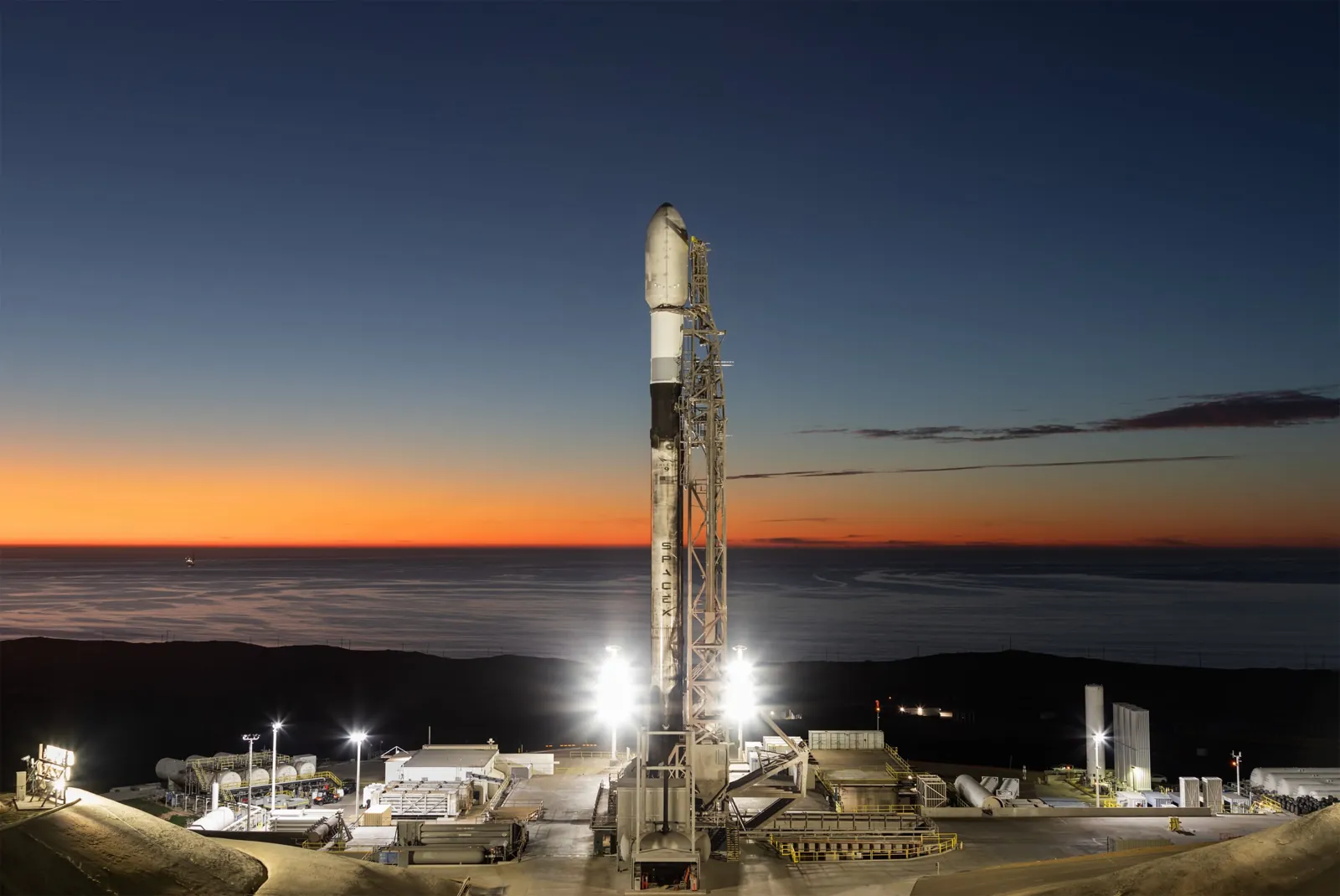 />
A Falcon 9 on the launch pad at Space Launch Complex-4E on Vandenberg Space Force Base. (Credit: SpaceX)
Falcon 9 is a two-stage, 70 m-tall, partially reusable rocket that uses nine Merlin 1D sea-level engines on its first stage and a single vacuum-optimized Merlin 1D on its second stage. Falcon 9’s first stage lands either aboard an autonomous droneship or at a landing site, with its fairings being recovered and reused after flight. Both stages utilize liquid kerosene and liquid oxygen as propellants.
Booster B1103 will be supporting this mission on its seventh flight. Previously, this booster has supported the launches of NROL-179, Tranche 1 Transport Layers A and E, and three Starlink missions. Falcon 9 will land downrange aboard SpaceX’s droneship Of Course I Still Love You.
On Tuesday, Nov. 10, South Korea is set to launch the second flight of Mir, the South Korean military’s small satellite launch vehicle. This launch is set to be the first orbital flight of the full-scale rocket, following a test flight in December 2023 that did not include the second stage. The launch window opens at 05:00 UTC and extends until 09:00 UTC.
Mir is a four-stage, solid-fuel launch vehicle with a liquid-fueled fourth stage for precise orbital insertion. The version that flew in December 2023 was capable of 700 kg to LEO, with this version suspected to be capable of around 1,000 kg.
Chang Zheng 2D | Unknown Payload
On Wednesday, Nov. 11, a Chang Zheng 2D (CZ-2D) rocket is scheduled to launch out of the Jiuquan Satellite Launch Center. The launch is currently scheduled for 11:40 UTC, eight minutes into a window that opens at 11:32 UTC and extends until 12:05 UTC. CZ-2D will deliver an unknown payload into orbit.
CZ-2D is a two-stage, 41 m-tall launch vehicle capable of delivering 3,500 kg to low-Earth orbit (LEO). CZ-2D’s first and second stages are both powered by dinitrogen tetroxide and unsymmetrical dimethyl hydrazine, both hypergolic propellants. Wednesday’s launch will be the 107th overall for CZ-2D, and sixth in 2026.
The second and final scheduled Chinese mission of the week will see a Kuaizhou 11 rocket launch on Thursday, Nov. 12. Liftoff is set for 19:50 UTC from Site 95A at the Jiuquan Satellite Launch Center, during a 45-minute launch window.
Kuaizhou 11 is a four-stage Chinese rocket manufactured by the China Aerospace Science and Industry Corporation. Standing 25.3 m tall, the rocket can loft 1,500 kg to LEO with a liftoff thrust of 1,250 kN. This mission will be the eighth overall Kuaizhou 11 mission and the fourth of 2026.
Vulcan VC6L | Amazon Leo (LV-01)
United Launch Alliance’s (ULA) Vulcan rocket is set to launch on Friday, Nov. 13, from Space Launch Complex 41 (SLC-41) at Cape Canaveral Space Force Station. The 30-minute launch window opens at 12:54 PM EST (17:54 UTC). This will be the first flight of Vulcan in over nine months, following the ejection of one of Vulcan’s GEM-63XL solid rocket boosters at T+69 seconds on the USSF-87 mission. Flying aboard Vulcan will be a stack of 40 Amazon Leo satellites for Amazon’s Leo satellite internet constellation, a rival to SpaceX’s Starlink.
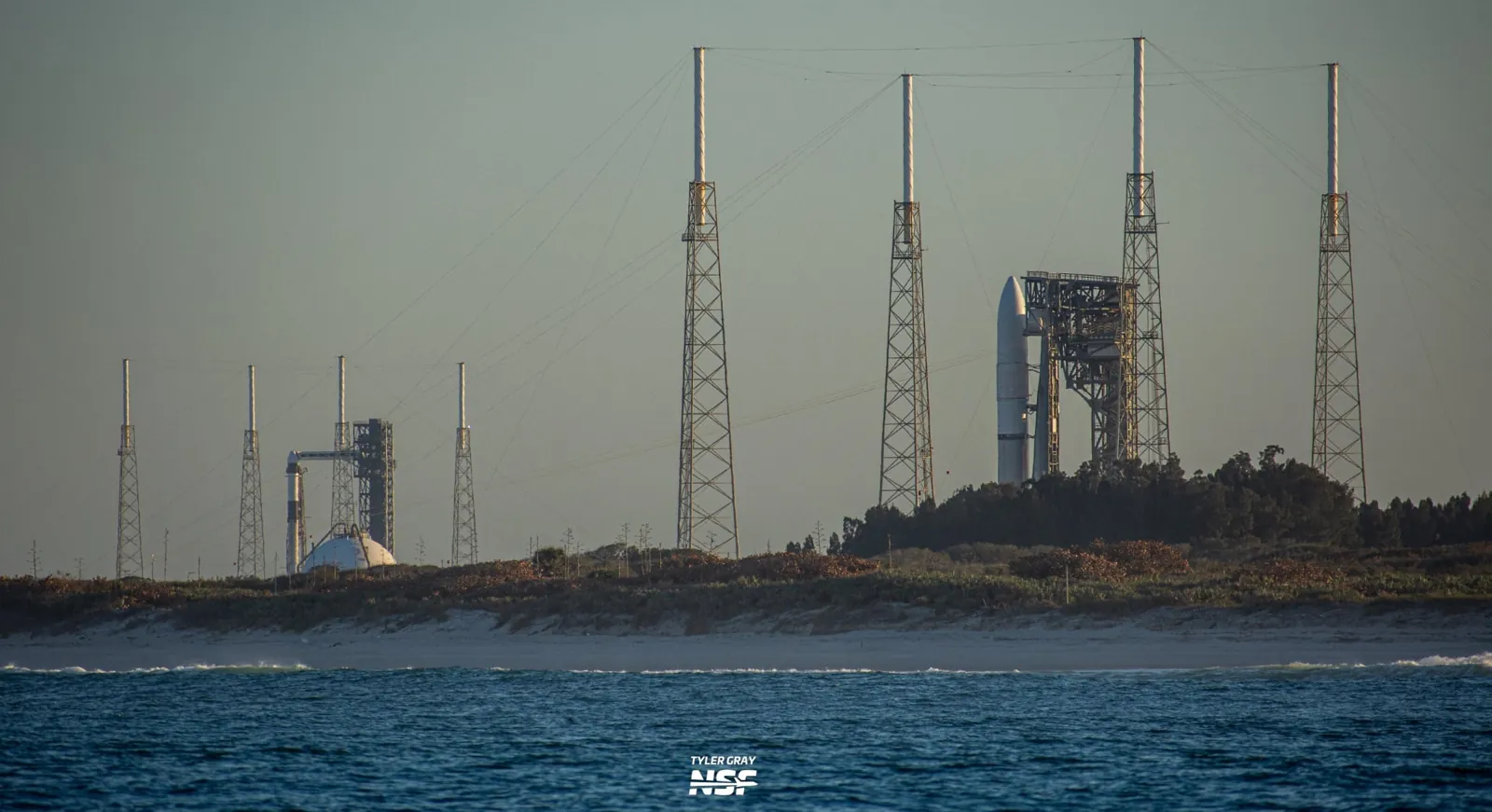 />
A ULA Vulcan (USSF-87) sits next to a SpaceX Crew Dragon (Crew-12). (Credit: Tyler Gray for NSF)
Vulcan is a two-stage launch vehicle with a range of launch configurations. Vulcan’s first stage is powered by two BE-4 engines built by Blue Origin, running on liquid methane and liquid oxygen propellants. Its second stage, Centaur V, is powered by twin RL10C engines running on liquid hydrogen and liquid oxygen. Centaur V can be configured as Centaur LEO, High Energy, or Endurance. Vulcan can also be configured with solid rocket boosters to augment liftoff thrust, with options ranging from zero to two, four, or six boosters. The payload is encapsulated by either a short (15.5 m) or a long (21.3 m) fairing.
Vulcan will debut the Vulcan VC6L variant, designated by six solid boosters and the long fairing option. Vulcan will debut the LEO-optimized Centaur V, which is 1.94 m smaller than the existing Centaur V High Energy, which has flown on all previous Vulcan launches. Additionally, this flight is a certification flight of this Vulcan configuration for the United States Space Force.
Amazon Leo (LV-01) will be the first of 38 scheduled for Vulcan and the fifth overall mission for Vulcan.
Starship | Flight 15 / Starlink Group 31-2
Pending regulatory approval, Starship is set to fly its next, and most significant, mission no earlier than Friday, Nov. 13, at 4:45 PM CST (22:45 UTC). The launch window extends until 6:00 PM CST (00:00 UTC on Nov. 14). Flight 15 will feature two notable events: the first booster-catch attempt since Flight 8, following stage separation, and the first attempt to catch the ship, roughly 22 hours after liftoff.
Starship is a two-stage, super-heavy-lift launch vehicle capable of lofting an estimated 100 tonnes. The first stage, named Super Heavy, features 33 Raptor 3 engines, running off of liquid methane and liquid oxygen propellants. The second stage, named Starship, features six Raptor 3 engines, three sea-level and three vacuum-optimized, also running off of liquid methane and liquid oxygen.
Flying on Flight 15 will be Ship 42 and Booster 22, both on their first flights. Flight 15 is expected to deliver 26 Starlink v3 satellites to LEO. Like Flight 14, three of these satellites will feature imaging capabilities for imaging the heat shield of Starship in orbit. Flight 15 will be the 15th full-stack launch of Starship and the fourth for the system’s V3 configuration.
Falcon 9 is set to fly again on Friday, Nov. 13, from VSFB with another USSF mission. The designation for this flight is USSF-317. The launch window opens at 8:09 PM PST (04:09 UTC on Nov. 14), and lasts for four hours. This mission will fly another unknown quantity of presumed Starshield satellites to LEO.
Booster B1100 will support this mission, marking its 11th flight. This booster has previously supported NROL-105, USSF-385, and eight Starlink missions. B1100 will land downrange aboard SpaceX’s droneship Of Course I Still Love You.
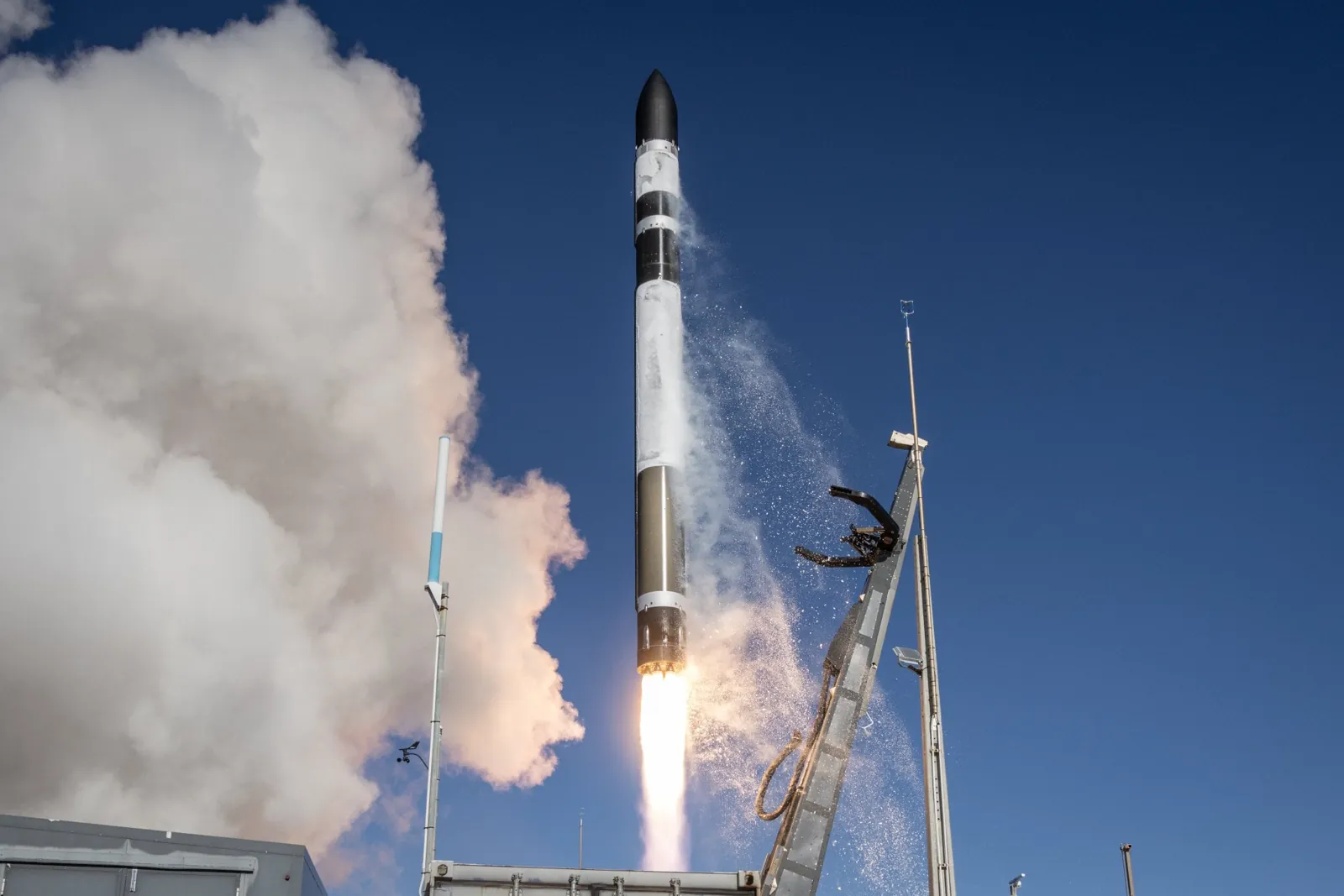 />
Electron during its 95th launch “Happily Ever Faster.” Credit: Rocket Lab)
Electron | The Mountain God Rises
The last scheduled launch of the week will see Rocket Lab’s Electron launch from the Mahia Peninsula in New Zealand on Saturday, Nov. 14, at 05:30 UTC. This flight of Electron, named “The Mountain God Rises,” will deliver another iQPS satellite into LEO for iQPS’s synthetic aperture radar constellation (SAR). SAR is used to image the surface of the Earth and can penetrate through cloud layers.
Electron is a two-stage small-lift vehicle capable of delivering up to 300 kg to LEO and 200 kg to Sun-synchronous orbit. The vehicle is fueled by liquid kerosene and liquid oxygen, which powers nine Rutherford engines on the first stage and a single vacuum-optimized Rutherford on the second stage.
This mission will serve as Electron’s 100th overall mission — a notable milestone for the small rocket that first flew in 2017. In addition, this mission will serve as the 269th orbital launch attempt worldwide in 2026.
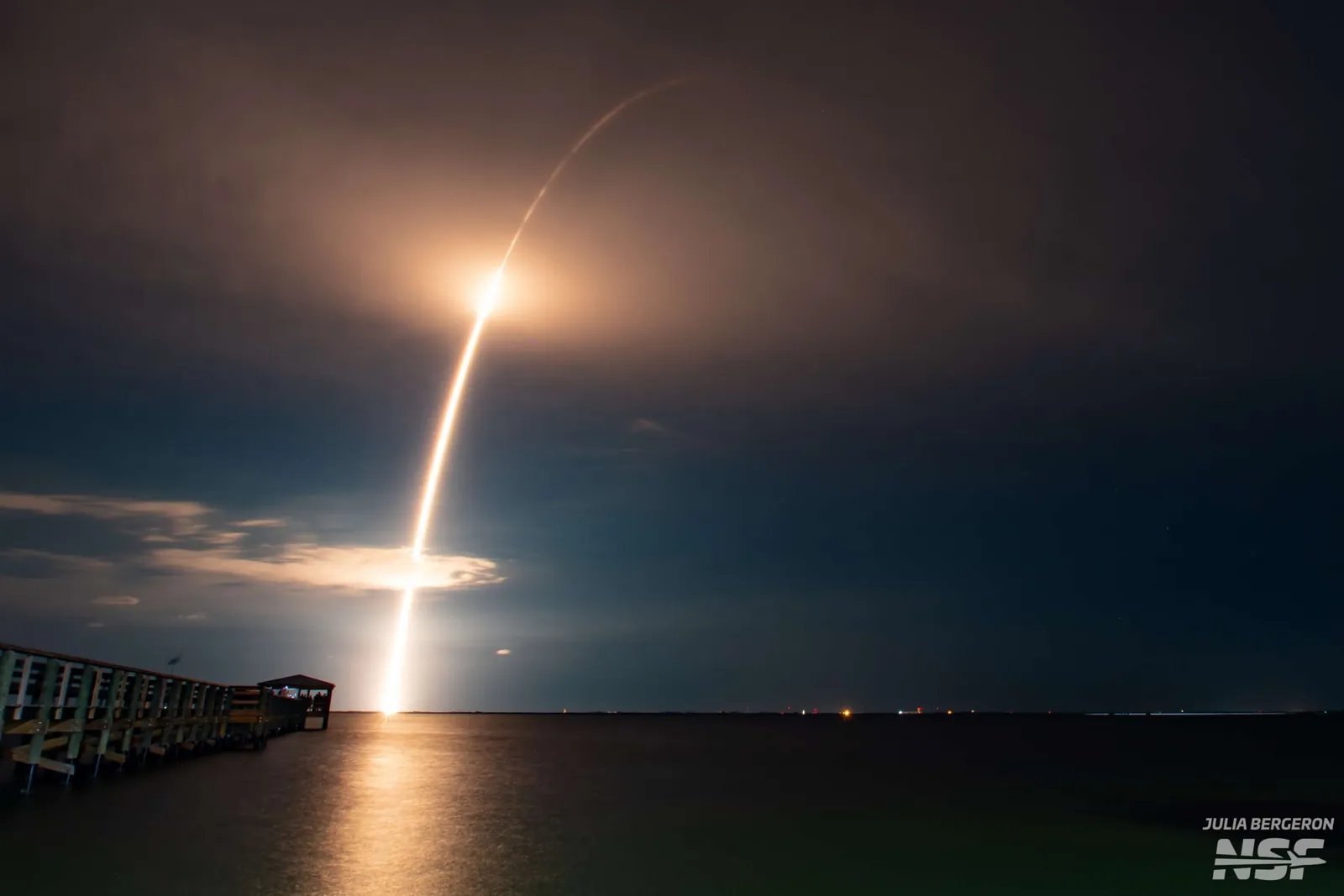
(Lead Image: Falcon 9 launches from Florida. Credit: Julia Bergeron for NSF)
Amazon LeochinaCZ-2CElectronFalcon 9Flight 15Kuaizhou-11MIRRocket LabSouth KoreaSpaceXStarlinkStarshipSuper HeavyULAUSSFVulcan 0 FacebookTwitterPinterestEmail previous article NASA’s Moon Base plan gains a PROMISE />